Voices from the New American Schoolhouse Trailer

In April, 2005, film-maker Danny Mydlack made a lovely documentary abour Fairhaven School, Voices From The New American Schoolhouse. Here is the trailer. Enjoy!

Danny staffed here at Fairhaven for the 2007-2008 school year prior to founding Arts And Ideas Sudbury up the road in Baltimore.

Prospect and Refuge, Hunters and Prey

Infected Pictures 009

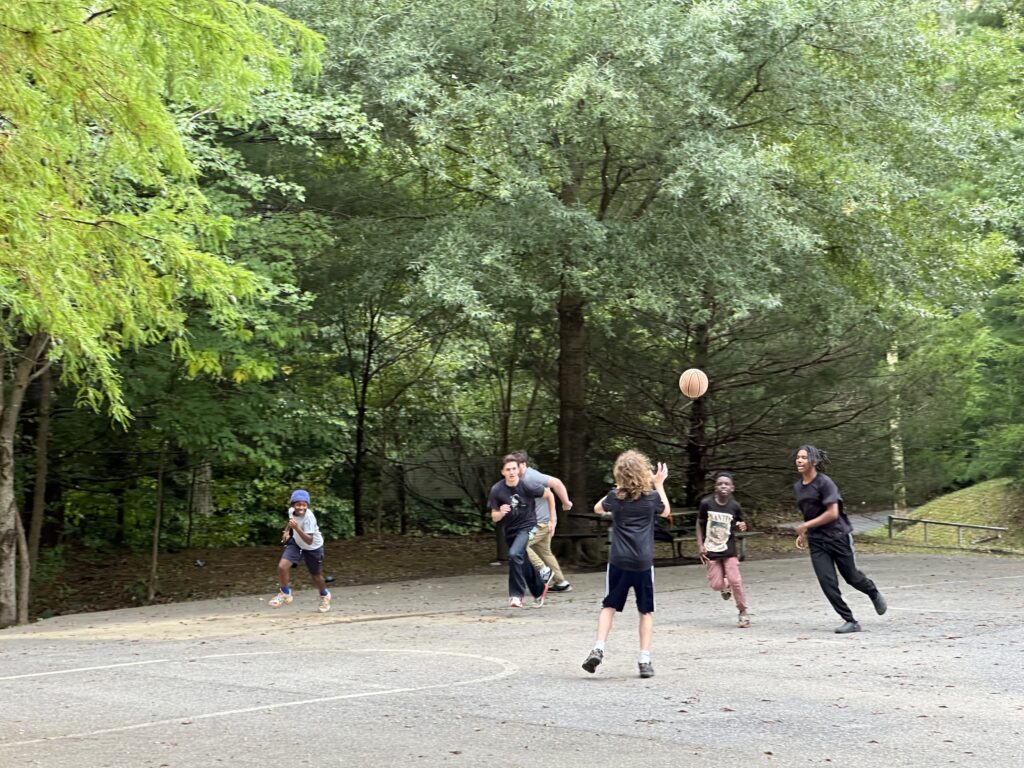
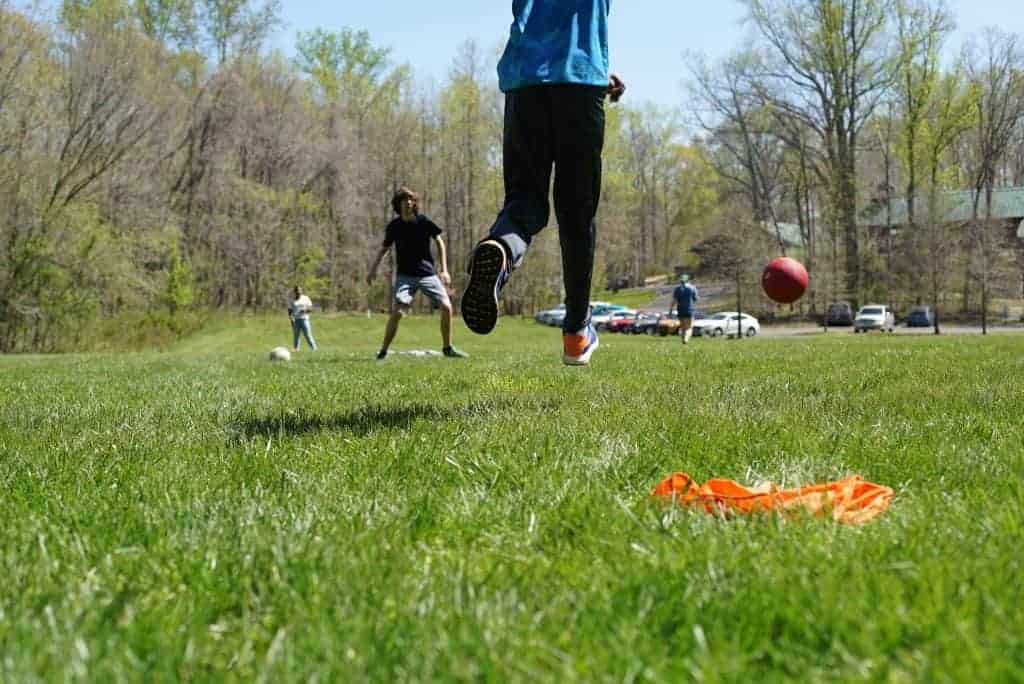
In the patch of woods just outside the school office, three boys sneak by. Two more lurk deeper in the trees. Suddenly, they’re sprinting across the school grounds. Two outdoor games have been big on campus  lately: “Hunters and Prey” and “Infected.” Both are hide-and-seek variants and can  involve anywhere from ten to thirty students at a time. Hallmarks include people flashing past, hiding as long as possible, and shouting from deep in the forest. Games can last for hours.

Crossing from one building to the other yesterday, taking a few minutes to deeply notice the players,  I again asked the question we ask so many times : what’s going on here? Obviously, the players are breathing fresh air, exercising, and developing relationships, all hallmarks of outdoor play. Furthermore, the open-ended quality of the games fosters critical and strategic thinking in the players. But what about these particular games makes them so compelling?

Intense games of hiding and seeking seem to reinforce biological drives and instincts. Quoting from landscape theorist Jay Appleton’s Prospect-Refuge theory,

“at both human and sub-human level the ability to see and the ability to hide are both important in calculating a creature’s survival prospects . . . . Where he has an unimpeded opportunity to see we can call it a prospect. Where he has an opportunity to hide, a refuge. . . . To this . . . aesthetic hypothesis we can apply the name prospect-refuge theory.”Infected Pictures 026

We are hard-wired, then, both to take refuge and to seek higher ground. For millions of years on the savanna, or in the woodlands, humans needed both prospect and refuge to literally survive. Here in the Mid-Atlantic, wolves are long gone, as are saber-toothed tigers.  Most students get their food from supermarkets. Still, they  satisfy basic drives when they play their games. Although whether or not they will survive may not be at stake, whether or not they will thrive surely is. Brains and bodies anticipate the need to find prospect and refuge, to seek and to hide. At Fairhaven, the students fulfill this need.

Our working thesis is that free range young people develop best. Playing Hunters and Prey, from a point of prospect, they are learning how to take stock of a situation and they then experience the good (or bad) things that this assessment brings. They are also learning how to hide, or more broadly put, to take refuge. Refining these individual traits in the social matrix of a game only intensifies their value. Given the stakes and the outcomes, the oft-repeated phrase it’s just a game falls short of the complexity.

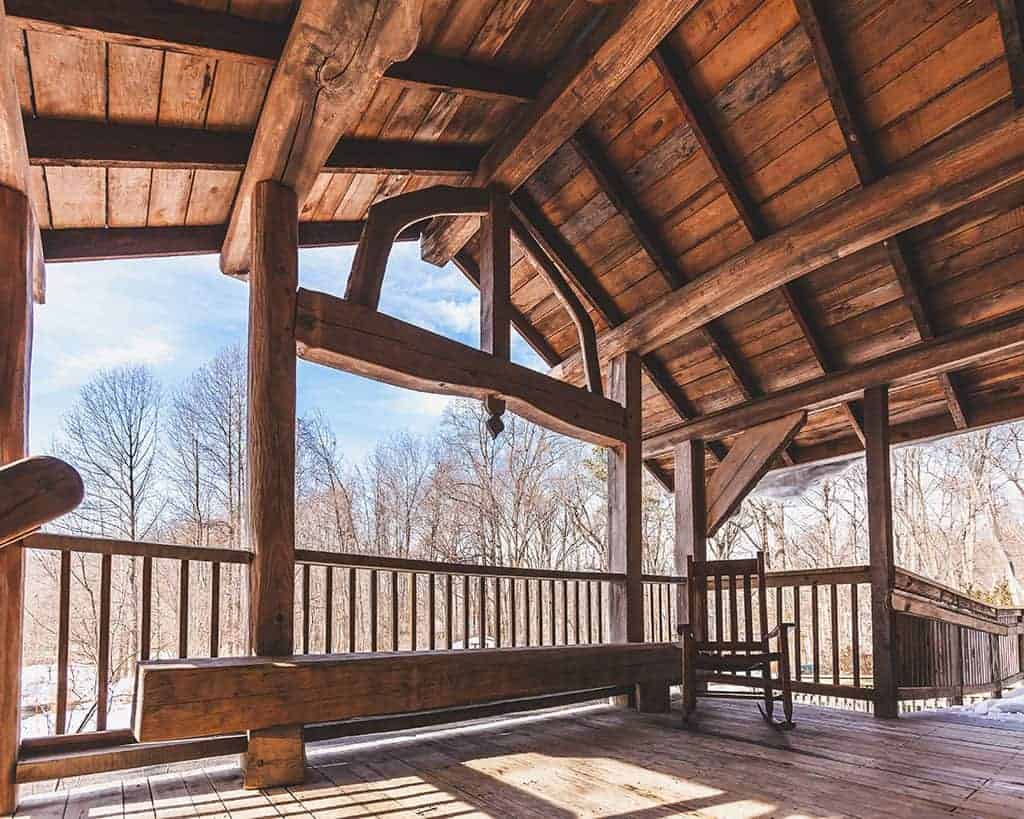
Later in the day, two students relax from the prospect of the wrought iron rockers on the porch, the highest ground at Fairhaven. Noticeably pleased to be blending in by talking with me, they tell me casually that they’re playing, that they’re part of the game swirling below. Nevertheless, some aspect of them stands ready, at a moment’s notice, to spring from their spots at the merest whiff of an approaching hunter.Infected Pictures 014

Mark McCaig

January, 2009

A Note From Kat Steigerwald, Fairhaven Class of 2004

Fairhaven alum Kat Steigerwald (left) graduating from Prescott College

Fairhaven alum Kat Steigerwald (left) graduating from Prescott College

December 10, 2009

Dear Fairhaven-ers,

I am finally graduating! There is actually snow on the ground here in Prescott today, which makes me think of Maryland. Please find my senior project enclosed. It recounts some of my experiences volunteering for hospice this semester- an amazing experience. I also have the honor of presenting my project at Baccalaureate this weekend. Prescott College graduation is a lot like Fairhaven- each student picks a mentor to speak about them, then the student has a minute to cry (or do whatever!)

Thank you all so much for being part of my journey. I know that I wouldn’t have found such an amazing college if my time at Fairhaven hadn’t empowered me to take responsibility for my education. Now I just need to find a grad school…

Love,

Kat

With Kat’s permission, below are some passages from her senior project, a booklet entitled Reflections On Being With Dying.

For this study I added an additional two days of hospice volunteering per week, in addition to the one day I have been doing at a care home for over a year. These two days took place in The Hospice Family Care inpatient unit, which houses patients who are in need of symptom and pain management, respite care, or who are actively dying. I also researched the psychological and emotional processes of death, dying, and bereavement to inform me of what I should expect to witness while volunteering. Part of my project also involved a more personal exploration of death that included doing meditations and practices to become mindful of my life and the inevitable end to it.

(from “Introduction”)

Another reason why I chose to spend time with people who are dying is that death is a completely universal experience. As  a future therapist I could choose to specialize in addictions, multicultural perspectives, or adolescence (to name a few), but emotional issues surrounding death is one of the few things that I can connect to everyone about….I am able to relate to hospice patients whose lifestyles are completely different from mine, because all of the differences fall away when we get down to the business of life and death.

(from “Facing Facts”)

Days have a way of passing and leading into the next so fluidly that it is not unusual to wake up one morning and wonder “how the heck did I get here?’ Finding meaning in life requires being intentional about how we spend those days. I agree with [psychiatrist and author] Viktor Frankl that participating in life creatively, experiencing the parts of life we believe to be of true value, and the attitude we take toward our limited time in this world will lead to a meaningful existence.

(from “Meaning”)

I remember seeing one particular patient, Wendy, who was very confused and quiet. In the beginning of my visit I found myself chitchatting quite a bit, and only getting brief, indifferent answers from her. Once I realized how much I had been leading the conversation I quiteted down and let her get lost in her own thoughts for a while…During her stories she spoke very slowly, only a few words at a time. “You don’t notice getting older,” she began slowly, “and then one day you are…” After an extended pause she concluded, “and surrounded by elderly people.” This insight was very sweet, and certainly worth the wait.

(from “Silence”)

It is a cold and cloudy day today, and although this project must now come to an official end I know that death and dying are subjects that I will continue to explore until my theoretical death becomes a reality. Reflecting on the questions and ideas that have arisen for me this semester has helped me clarify how my relationship with death can make me a better counselor, volunteer, and friend. I will continue to foster gratitude, compassion, intention, a search for meaning, and the ability to sit with suffering in my life. And, knowing that there may not be a tomorrow, I am now going to throw on a coat, strap on some boots, go for a walk, and seize the day.

(from “Conclusion”)

Thanks, Kat for sharing your project with us. And Congratulations!

In Tribute

fall2Just before Winter Break, after more than twenty years on the forefront of education, our colleagues at the Sacramento Valley School voted to close the doors on their Sudbury school. As one of the first generation of schools who modeled themselves after Sudbury Valley School, SacVal has served as an inspiration and support to us at Fairhaven School from the beginning.

At Sudbury schools conferences, the wise words from SacVal staffers always got our attention. Likewise their contributions on our listserve. Two Sacramento Valley staff members, Kaye-Lynn Peterson and Brenda Gustin,  served on Fairhaven’s Diploma Committee in recent years. Former Fairhaven staff member Cameron Lyons used to work at Sacramento. We Sudbury schools are a small community!

As you good people move on, we write to offer our gratitude, appreciation, and these words of encouragement: your work has changed hundreds of lives, and bolstered thousands. May we all be so lucky!

Best,

Mark McCaig

and the crew at Fairhaven School

Fairhaven School Slideshow

A slideshow of Fairhaven School presented at the Greenfest during October 2009.

The Play’s The Thing

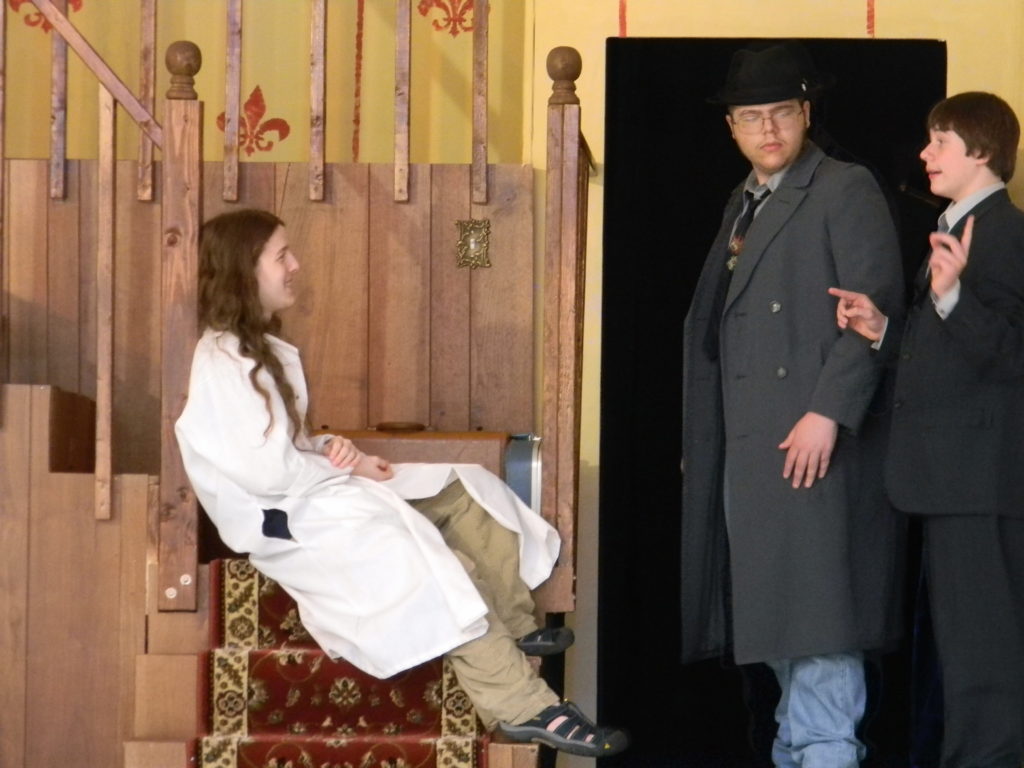
Like any good theater project, Fairhaven’s recent outdoor production of MacBeth proclaimed its merits on many levels.  Student actors, crew, and sound all executed their jobs with distinction. Fulfilling the doomed Scottish king’s prophecy–Blood…there will be blood–oh, yes, there emily macbethwas blood.

The autumn trees made a perfectly gloomy backdrop. The witches bewitched and the swordplay thrilled. Befitting the curse of the “Scottish play,” numerous leads fell ill a week before show time (see previous post “What Are We Teaching These Kids”), yet all but one cast member trod the boards. An enthusiastic audience came both days, and the familiar feeling for those of us who participated or watched was, indeed, the feeling of witnessing a small miracle.

This piece, however, is not meant as a review. Both my cameo as the Porter and my longstanding membership in the Theatre Corporation here at school taint my objectivity. Watch our website for more photos.  If still intrigued, re-read the play itself! Thinking about the production has refreshed my understanding of the educational milieu here, and has led me once again to the most common activity on campus: play.  Paraphrasing something Sudbury Valley staff member and writer Daniel Greenberg once wrote, “play” is any activity where the activity’s outcome is not pre-determined. It can take shape at school as dress-ups, make-believe, knitting, sports, cards, video games, hide-and-seek, and acting in a Shakespearean tragedy. Or maybe it is more nebulous: playing with ideas, joking with your friends, planning a fort, doodling, fooling around on the piano. A paradox is that play looks trivial, but is also a serious activity for our students, a crucial accelerant for growth and development.

One image from Greenberg’s piece that stuck with me was the idea of “play” in a rope. A rope with play has a little slack, right? Watching my colleague Ruth direct MacBeth reminded me of how this notion of play, well, plays out here at Fairhaven. I ran lines one day when the director was absent. Goodness, it seemed to me nobody knew their parts! Fighting my urge to control, I gave gentle reminders and prompts. Later, in classic theater fashion, the dress rehearsal was a mess. Ruth was almost pleased: “Bad dress, good performance.” When the adage proved right-on, I realized that directing theater is so much like working at Fairhaven School. In any good example of work or play, doesn’t the art lie in the lovely line between controlling and letting go?

Staff members draw this line and re-draw it every day on campus. In School Meeting or JC, how much should we dominate the discussion? How much should we hold back? A student needs some support putting on the Talent Show: how much is too much? Somebody has stopped coming to Writing Class: do I encourage her once to keep coming or just let it go?

Students also ask and answer these questions about their lives at school. Some have elaborate schedules and plans; others flow from day to day, capricious. Some free-flowers become planners over time, and some planners learn to go with the flow. The art lies in the lovely line between controlling and letting go. He wrote truth, when Shakespeare wrote, the play’s the thing. Maybe this synchronicity between school dynamic and theater dynamic explains Fairhaven’s incredible run of successful plays through the years. We Theatre Corp members hope thMacbeth witchesey continue, knowing one day they may cease.

All the world’s a stage, and all the men and women merely players.

Mark McCaig

November, 2009

What Are We Teaching These Kids?

Tickets for the Scottish play: "There will be blood..."

Tickets for the Scottish play: "There will be blood..."

I recently had the great honor of directing a play at Fairhaven. Many know that theatre is very near and dear to my heart. I formally taught it in the public schools for many years. Throughout my time there, I was constantly battling budget cuts, focus on core subjects, emphasis on the sports program…one gets the idea. I saw myself as a champion of the arts (theatre in particular). It seems to me that one could learn just about anything one would need in life by just putting on a play.

Time management skills are a first big skill that comes to mind. I hand out a schedule early (before auditions) in the process and ask the students to work their lives around it. It is a thrill to be in a place where students want to do theatre and can commit as much of their time as they wish to the endeavor. It also proves a challenge in that, here at Fairhaven, there seems to be so many ways students can spend their days:  it’s  a capricious situation.

Commitment: a show just won’t be as successful if everyone isn’t dedicated to the project. The cast of this production, unfortunately, had a run-in with illness. In production week, the week leading up to performance, we were missing three of our leads. I had many conversations with worried actors and parents and discussions about postponing the show. In those conversations and at Theatre Corp (the decision-making body), I whipped out the old “the show must go on” adage which prompted the quote that I’ve used as the title of this piece.

Yes, we were down some very important actors. Yes, the show would not be as it had been dreamed or rehearsed. Yes, I had made a commitment to the rest of the 18 cast and crew members and community to have a show on the days I said I would. Please understand, it was never my intention to question parents as to how to convalesce their children. I am not a “what price glory?” (sorry, another cliche) sort of person. I am also not about questioning the commitment of the ill actors. I know they were deeply invested in the play, and it was a huge disappointment for the one actor who was not  able to perform. Perhaps Malcolm said it best in Act IV: “I would the friends we missed were safe arrived.”

However, we honored everyone else’s time, energy, and commitment. What are we teaching these kids? That everyone worked hard, and that sometimes, the show does have to go on.

Bravo actors, crew, and audience. It was a play well done.

Ruth Yamamoto

All In Favor Of Honesty?

“She wouldn’t play with me, even after I asked her!”balance-409

She’s young and she’s upset. Her friends at school console her in the stairwell when she cries about the incident. Staff members, including me, check in, see she’s upset but okay, and move on. Although the intricacies of why these friends are in conflict are lost on me, whatever happened out on the swings really matters to them. I listen to their concerns, but do not try to “fix’ their dispute, leaving them in the capable hands of an older student.

Although the adults at other places may intervene, here is where our school culture stands: the other girl does not have to play with her if she doesn’t want to, even if her friend is very upset. Our students have the right to decide their playmates. Many, many elements compose the educational experience of Fairhaven and other Sudbury schools, including an array of freedoms: freedom of speech, freedom of movement, and  freedom of thought. Add to these freedom of assembly, a civic right that usually calls to mind people gathering to protest government actions or policies. The right of our students to play with whomever they want, and to not play with whomever they don’t want, is perhaps a cousin to their freedom of assembly.

If curiosity compels me to dig into why someone doesn’t want to play with someone else, there’s almost always a compelling reason. Sometimes it is “I want to be alone,” but more often a it is version of  “she’s not nice.”

Welcome to the world of honest feedback, people. At Fairhaven School, we value candor. A recent School Meeting had many questions and comments for Judicial Committee (JC) candidates, questions that did not pull punches about their qualifications for the crucial job of overseeing the system that maintains order at school:

“Both of you are intense and passionate, and you’ve had problems with each other. Do you really think you can work together?”

“No offense, but sometimes when you ran it before, JC was really slow.”

“Because you stay up too late, sometimes you lose focus during JC.”

Straightforward debate and inquiry, the lifeblood of a free society, is a hallmark of our school culture, nowhere more than at School Meeting. After hearing what her peers said, one JC Clerk candidate smiled knowingly, nodding. She did not storm out of the room. She knows herself and is comfortable with hearing about her shortcomings. After everyone had their say, including the candidates, the School Meeting Chair called for a show of hands: “all in favor of Lucy and Daisy for Clerks?” He counted hands. “All opposed?”

Every six weeks, we elect new clerks, and often people do not succeed. School Meeting members (staff and students) have a keen sense of who’s qualified for the complexity of running daily judicial meetings. One student tried for years before getting elected. Each May, candidates for staff undergo the same rigorous scrutiny during our staff election process. (Nobody has tenure at Fairhaven.) Is this candor difficult? At times. Is it beneficial? Absolutely. In a transparent, honest, democratic community, people at Fairhaven tend to know where they stand.  Establishing this culture has taken time, but could there be a better starting place for healthy development than “knowing where one stands?”

Ten minutes later, the stairwell is quiet again. The girls have worked out their differences. Despite a little redness around her eyes, the upset girl seems fine. Or maybe she’s a little better than fine, because she’s on firm footing as she runs out back, laughing with her friends on the way to the swing set  for another go at this thing called life.

Mark McCaig

October, 2009

The Shapes Of Thoughts: Field Notes From The First Month

Student Art 1

Student Art 1

How does a mind grow?

How does a person become a person?

Sometimes the best measures are collages, as thoughts take shape before our eyes. In no particular order, then, here are some things we’ve seen and heard in this, the first month of our twelfth year at Fairhaven School :

The twelve-foot swings arc all day. So does the forest tire swing.

Staff and students debate and modify a complicated policy about attendance sign-out. New voices emerge at School Meeting.

Board games proliferate.

Macbeth is cast for a  Halloween production of the creepy “Scottish play.”  Rehearsals take place on the covered porch under the watchful eyes of the director. Leaves turn as cast members hone their fight scenes.

Oak trees drop more acorns than any year in recent memory, many thunking on the metal roofs.

JC sentences a student to remove acorns from the driveway circle flower bed.

The Pr Committee launches a new website and tables at two festivals.

Half the school field trips down Route 301 to the corn maze and pumpkin patch.Entering Maze

A student crafts cute yarn critters for her new friends in the Lyons Den (the Art Room.)

New students discover the perimeters of behavior by way of JC and School Meeting. Peers weigh in on every judicial decision.

Many classes start; some continue.

Day after day, dozens try to capture the flag on the field.capture-flag-4091

Computers, computers, computers.

Students play “Hunters and Prey” in the woods.

Some of us follow the strange saga of “Balloon Boy” live on a computer, horrified when the homemade helium craft crashes, relieved the next day when it turns out  he is alive and well at home.

School Meeting elects JC Clerks and alternates. The wheels of school justice turn and turn.

Corporations elect their executives as well. These students  run the meetings that will manage the computers, the art supplies, the Macbeth production, the kitchen, the shop, and other aspects of the daily life of the school.

Alumni visit, checking in about their lives after Fairhaven while reliving the singular experience of being here.

Conversations outnumber even the acorns.

A new young boy trots by and says to his pal, “You’re a bad dog, and I’m a bad dog.”

Still running, his fellow canine says, “No, I’m a good dog.”

Dog boy 1 regresses, saying only, “Woof.”

And so it goes!

Mark McCaig

October, 2009

A Process of Conversion


by Gene E. Gary-Williams, Ph.D.

I freely admit that my first encounter with Fairhaven came as a result of panic and prayer. My grandson, who was 8 years old at the time, had provided early and consistent indication that traditional schooling was not for him. Further, it appeared that if the adults in his life insisted on pursuing this line then we all were in for a rocky and rough path with uncertain and maybe disastrous results. He had been exposed to Montessori, traditional private schooling and home schooling – nothing worked in the manner to which most of us is accustomed. Making all of this the more frustrating was the observation that he is incredibly bright, intellectually gifted and possessing a phenomenal memory.

One day in the spring of 2005, I came across an article in The Washington Post that appeared above the fold, on the right hand side of the A section – hard to miss and strategically placed. Upon completing the article, I gave it to my daughter to read and stated that we needed to find Fairhaven, that very day!! We all got dressed for a visit – my daughter, my grandson, his twin sister, and I. We were greatly surprised and pleased to find that the school was about 15 minutes from our home!!! Upon being graciously received for our impromptu visit, taken on a tour and given a brief overview of the school, we were scheduled for an official visit. In the meantime, my grandson had declared, from this brief encounter, that this was a school that he liked; instant identification with the environment.

The long and short is that after the official visit, he spent a week to get the feel of the place and my daughter enrolled him for the upcoming school year.

He will begin his fourth year in this academic year, 2009-2010. In the meantime his sister who is a completely different learner joined him last academic year and she has positively thrived – much to my surprise.

So, why am I surprised? To begin, I am a traditional academic, having taught in higher education environments and served as an administrator in these same areas. My orientation is in traditional schooling, where I excelled as a learner. As an academic I have an awareness of non-traditional modes of educating, but had never explored these before some cursory looks at Montessori. NOTE: When attempting to introduce other traditionalists to the Sudbury concept, I frequently refer to Sudbury as Montessori Very Lite!!

I was not sold on Sudbury in the beginning, I just knew that for the mental health of the family, it was at least a respite; maybe until we could figure something else out OR find some other, more familiar, form of educating that may answer my grandson’s needs.

At this juncture, I have a number of observations that have contributed to my continuing conversion and that have affirmed the importance of the Sudbury education model. First, listening to NPR WAMU 88.5 one day, after my grandson’s enrollment, I heard an interview with a young woman who had received a non-traditional education (not Sudbury, but home schooling to meet her needs) and who has written a book entitled Quirky Kids. She identified and interviewed young people who were educated apart from the traditional methods and wrote about their journeys. During the call-in, a parent from Florida described the hell that her family had encounter with her then 13 year old son and the finding of a school that assisted him in responding to his learning needs. As she talked, I realized that she was describing a Sudbury school and her story of her son’s development was a breakthrough moment of hope for me.

Since that time I have had moments of panic – most often when I discover that the kids do not know or understand some principle of Arithmetic/Math or some basic English language principle or how to spell a word that should be a part of their total vocabulary. The traditionalist in me takes over and I want to supplement Fairhaven with my version of ‘this is what you should know at this stage of intellectual development’. Admittedly there have been times when we have defied the advice of the staff and offered some worksheets, etc.; it only lasts for the moment and we are back to where we were. I have found that correcting English at the time is a positive way of teaching, as both children tend to remember the corrections. Math is another whole ball game and I await the awakening that I have been told will happen and the subsequent push to make up for lost time or just to learn basic facts in order to move forward to another learning experience.

Finally, I am amazed at what each of the children, especially ‘the boy’ with his remarkable memory, do know. How and where they have learned some things will probably always remain a mystery. Basically, they know what is of interest to them. This offers a personal platform for learning other things, a concept that I can oftentimes forget in the emotion of learning to accept and believe in Sudbury methodology.

Finally, when I discuss this with different people, I frequently hear that the person wishes s/he may have had this type opportunity during their developmental phase as they still have a bad taste from traditional education or they feel this type experience would have enhanced their later choices. And everyone seems to know someone who was/is ideal Sudbury method material.

As an academician I have a great desire to verify what I observe with an evidence base. I have read the studies conducted about Sudbury graduates and appreciate these. However, my grandchildren are of a generation/group of children who have spent little or no time in the traditional learning environment. I await the evidence that they, too, can develop and present a thesis paper indicating an acceptable level of mastery of the language, including writing and thinking. I look forward to Mark McCaig’s next book!!!!!

Conversion continues. I am closer today than I was three years ago and hopefully not as close as I will be in the coming years.

FairHaven is an ideal choice for the name of this school – a wonderful respite and personal developer – which, regrettably, does not happen often enough in the ‘regular’ education environment.

Gene Gary-Williams, Ph.D. is a grandmother and former health care professional and academician. She is retired and volunteers with a number of organizations, including AARP.