In 2008, Fairhaven School co-founder Mark McCaig published Like Water, giving us a fantastic snapshot of the Sudbury model in action. Fast forward nearly two decades, and Mark is back to revisit the book in a new afterword titled “Still Water.” We invite you to listen to Mark read the new afterword as he explores what’s changed, what’s completely new, and how Fairhaven’s foundational core values of student freedom and responsibility are still going strong.
Still Water
..I come into the presence of still water.
And I feel above me the day-blind stars
waiting with their light. For a time
I rest in the grace of the world, and am free.
~Wendell Berry
from “The Peace of Wild Things”
Arriving at Fairhaven this October morning, I hear the first White-throated Sparrows of the fall chirping from the edge of the forest, where the leaves on the hardwoods are turning red and yellow, orange and brown. Soon, hundreds and then thousands of them will fall, and students will chase the spiraling leaves, an annual image of their remarkable freedom, young people laughing and running across the campus just like their predecessors did that first autumn in 1998.
Opening the empty campus, I turn on the lights in each room. An observer outdoors would see the two buildings awaken, one light at a time, each moment creating the possibilities for the day to come: cooking and eating in the school’s two kitchens; administrative work in the office; card games in the Meeting Room; imaginative play everywhere, especially, though, in the playroom we call the Kid Nook; music in the studio; play rehearsal in the Chesapeake Room; drawing and pottery in the Art Room; computer and tablet use throughout; jurisprudence in the Judicial Committee (JC) Room; woodcrafting in the Shop; conversation and play, well, everywhere.
Approaching its 30th year, Fairhaven School continues, a beacon of freedom and responsibility where young people get to know themselves and others, each of them building a foundation for whatever comes next, always in the complex dance between established school culture and change. As an institution, we’ve learned a few things, but close observation still reveals something new every day.
We have learned that the Sudbury model works. When parents and our school trust young people to manage themselves, and when they are given the time to do so, they develop an essential understanding of the life skills needed to succeed in today’s world. Fairhaven’s combination of student freedom and a democratic structure creates a system that works where stakeholders debate the balance between the freedom and rights of individuals with the needs and responsibilities of the group. What better questions are there?
Indeed, amid all of the talking on campus at Fairhaven School, questions abound:
What are you doing?
How does that work?
Can I join your game?
How do I change the Rooms Without Food rule?
Who certifies for online safety?
What problem are we trying to solve today?
Have you seen Vera?
Who didn’t clean up the cushions in the Kid Nook? Who did?
Will you accept a nomination to be JC Clerk?
Will you umpire the kickball game?
Underpinning all of these, our students get to ask of themselves the following:
Who will I be today?
Just a few weeks ago, two older students sat at the table on the porch adjacent to the Art Room, a popular spot to eat, hold meetings, or just chill with friends. One of them had an open laptop, surely a common sight; however, both wore safety glasses, an unusual sight outside the Shop.The other wore dark gloves on his very busy hands. What are you doing? “Flintknapping,” came the reply: the ancient art of shaping stone into implements such as arrowheads by using other stones or tools. He showed me some of his impressive, finished products, and I learned something new. We agreed on the importance of cleaning up the glassy shards on a campus where so many people continue going barefoot, and he got back to work. Fairhaven strikes again.
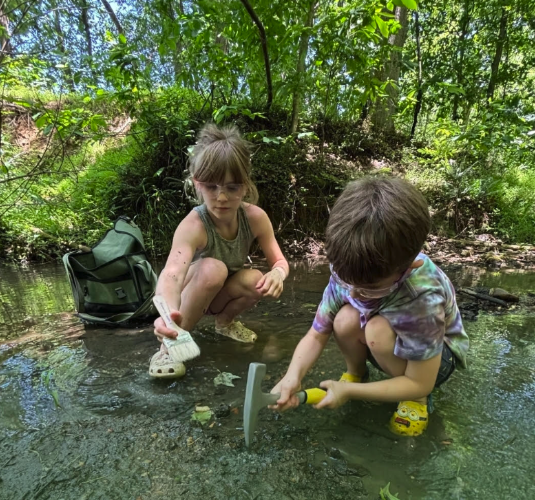
A cluster of students hustles past the same porch, more purposeful than the usual sprint to the playground. I notice Steven and Vera, and I know what’s going on. Last year, these two became the unrivaled fossil hunters on campus, so they, and a few others, are headed to the stream bed to see what the recent rainstorm has kicked up from the ancient ocean floor. Some people simply have a knack and interest for finding fossils. Separated by age and social circles, these two nevertheless share this passion, and during each exploration tend to find handfuls of shark teeth and other relics of the Eocene epoch. Other students and staff members often tag along, admiring this unique skill of Steven and Vera and learning, always learning.
When they return to the New Building, I ask to see the day’s finds: several teeth each, mostly extinct Sand Tigers, and two Otodus. I take pictures, and, of course, we look them up on the internet. I send images of two unidentifiable finds to a Fairhaven graduate who spent hundreds of hours looking for fossils. As an adult, she has turned her internship into a part-time job in the Paleontology department at the nearby Calvert Marine Museum. She’ll get back to me soon.
We keep in touch with her and scores of other alumni, and we’ve interviewed many of them for The Fairhaven Stream, our school’s podcast. We notice some patterns: Fairhaven alumni tend to be self-starters and leaders out in the world, whether in colleges and universities, in places of work, or in social groups. Years of pursuing passions, figuring things out, playing, and collaborating on managing the school have produced interesting, authentic, and productive adults. Steeped in the dynamic matrix of people at Fairhaven, their social intelligence and communication skills tend to be remarkable. They know themselves, and they remain curious about others. Whether they graduate from Fairhaven and enroll in college, or get jobs, alumni quickly adapt and tend to do very well. They pursue further schooling when they perceive value in doing so.
What kind of student thrives here? Are there some who don’t? In our school admissions, our number one priority is safety, both for the prospective student and the rest of Fairhaven School. Students here must be independent enough to manage themselves, within the framework of the school’s rules and regulations. We attract students of all types, and we remain committed to diversity, equity, and inclusion, both in admissions and in the day-to-day life of the school. Ultimately, this commitment is to safety, for Fairhaven welcomes all identities, and the people here experience the world in a wide variety of ways. Lately, we have seen an increase in neurodivergent people, and, again, if they can go about their days here independently and safely, they’re not only welcome here, they simply enrich the school for everyone. In this way, they are no different than anybody else. In the endless project of explaining Fairhaven, we sometimes describe the school‘s program this way: figure out who you are, and get better at being that person.
For the first several weeks of this school year, our youngest students chose to spend time with me, often playing Kings Corners (a card game) or doing pretend work while I’m accomplishing administrative tasks on the computer. Now in October one of them rode by me, happily carried on the hip of one of our teenage girls, swept up in the swirl of the school day. She may stop by my office and play a game for old time’s sake, or maybe when her friends have gone home for the day, but mostly she’s joined the broader life of the school. Truly, Fairhaven’s mixed age environment continues to be the catalyst for much of the energy of what happens here, as our students develop and maintain friendships with people close to their ages and people much older or much younger than they are.
Fairhaven School is about as old as the functional internet. How has increased connectivity and access to the web changed the school? We like to tell people that whatever’s happening in the world beyond the school’s twelve idyllic acres eventually comes to Fairhaven, so naturally students and staff members spend more time on screens than in 1998. In fact, the School Meeting, the JC, and the Electronics Corporation have spent almost thirty years discussing internet access, writing new policies about access, and investigating potential rule violations online. For generations of students, Fairhaven has been a thinktank for how to ensure that students can avail themselves of this remarkable resource while safeguarding students and the school itself against the potential harm of some of the content.
We support computer literacy, competence, and self-regulation. Therefore, when using devices to go online, all School Meeting members must follow the many pertinent school rules and policies, all voted upon by staff and students together in the weekly School Meeting, and these regulations are the only restrictions imposed on students regarding screens. We collaborate with students when new questions or concerns arise. When Fairhaven students are online, whether via smartphones, tablets, or computers, more often than not, the activity includes a social component. Finally, even our most dedicated gamers and phone users exist in a school community that includes near constant other activities. Every single day, students may be making music, creating art, building things in the woodshop, exploring the forest, playing games, building forts, serving on JC, making lifelong friends, and manifesting Fairhaven lives that even our oldest alumni recognize whenever they return. In sum, as with any institution in this digital age, the internet has in some way or other enriched almost everything at Fairhaven. Nevertheless, the school’s essential values of freedom and responsibility and its unique school culture ensure that everyone here has the autonomy to decide and discover what this digital age looks like and feels like for themselves.
The Electronics Corporation has often drafted the policies about internet usage at Fairhaven School, and it’s but one of many examples of ‘Corps’ that manage subsets of the school’s program. When we describe Fairhaven’s established school culture, the democratic work of corporations and committees are often the weekly stewards and creators of how things work here, and students play very active roles in these. Musicians populate the Music Corp and manage the Music Studio, artists do the same in the Art Corp, IT students join the Electronics Corp, and so on. We have seen many students participate in these lower stakes meetings that align with their interests before navigating the complexities of the School Meeting and the Judicial Committee. Alumni tell us over and over that their experiences managing the school here sends them into both academia and work environments with a rare and quite valuable skillset for working with others.
On the other hand, students continue to play here as if it’s their job, and, frankly, it is. Popular games vary, but this month includes lots of soccer, basketball, four square, and tag games. Students continue to love and maximize the swings and seesaws. They’re building forts and making toy weapons. They’re having “wars” and climbing trees. Indoors, digital games, card games, and imaginative games like puppies and family are common sights. Yesterday, I heard the familiar cadence and back and forth of two of our youngest students lost in their imaginations, this time pretending to be robots in the Kid Nook, the latest iteration of what first generation Fairhaveners called the Paper Game. Nearly three decades of observation and experience have only strengthened our belief that play remains the most efficient, natural, and productive way for young humans to grow and develop into healthy, successful adults.
Complementing all of this play on campus, students also continue to respond to the world creatively. Some of the more recent iterations have been extensive electronic music composition in the studio, countless pixels of digital art, anything you can imagine on the 3-D printer, wondrous ceramics fired right here on campus, and of course plenty of stories and poems. Play itself is at its core a creative process, so the line between play and art often blurs here. And, yes, our beloved Theatre Corp continues to stage plays in the Chesapeake Room, often elaborate, student-directed productions that seem to overtake most of the school in their creative flow, culminating in sold-out shows and the joyful exhaustion of a job well done.
Fairhaven School continues to call itself a Sudbury school, and we collaborate with Sudbury Valley School and numerous other Sudbury schools worldwide. We’ve hosted many visitors from sister schools, and we remain quite grateful to the founders and people at Sudbury Valley. While we at Fairhaven School attribute many of our core principles, practices, and procedures to our mentors in Massachusetts, we have also developed our own school culture and ways within that framework. Visiting any Sudbury school remains at once familiar and unique, as is appropriate for self-governing, independent institutions. Each one embraces the concepts, then develops their own version suited to their realities and people.
After all of these years, we understand that not every family will embrace our program and philosophy for their children. However, since we have seen generations of alumni leave here and thrive, and the lives of young people beyond our campus seem to be more and more managed by parents and schools, by coaches and teachers, we cannot help but ask questions. When do those children develop the muscles of autonomy that only freedom grants? When do they get to fall down and get back up? How often do they get to debate and vote on something that truly matters to them? Does a managed childhood lead to a fulfilling, creative adulthood?
As the day winds down, I cross the campus, inside and out. When the wind stirs, two acorns clank the green metal roof. I ignore two younger students crouched under a porch, spying on me, giggling, as if I cannot see them. I play along. I collect a couple of jackets for the Lost & Found, always something to tidy here. Someone announces that “it’s 4:50” over the intercom, time to gather belongings and prepare for going home.
Soon I see the same two young people climbing the Japanese Maple between the Old Building and the swingset, planted in the summer of ‘98 but now some twenty feet tall and sprawling at least that far across. The tree features scarlet leaves and multiple leaders that create several climbing routes and opportunities. In some education circles, people use the term “natural learning,” but we avoid the jargon, since such language can create as much misunderstanding as clarity. For us, “natural learning” is simply the byproduct of whatever the self-directed young people here may be doing with their time. Oblivious to the 4:50 announcement, these two Fairhaven students up in the tree simply are: still flowing like water up and down the branches when they hear with me the eerie call of a Barred Owl from the nearby forest. For this moment, we rest in the grace of the world, and we are free.
Mark McCaig